
Aerial dominance: is it really the key to being a top attacker?
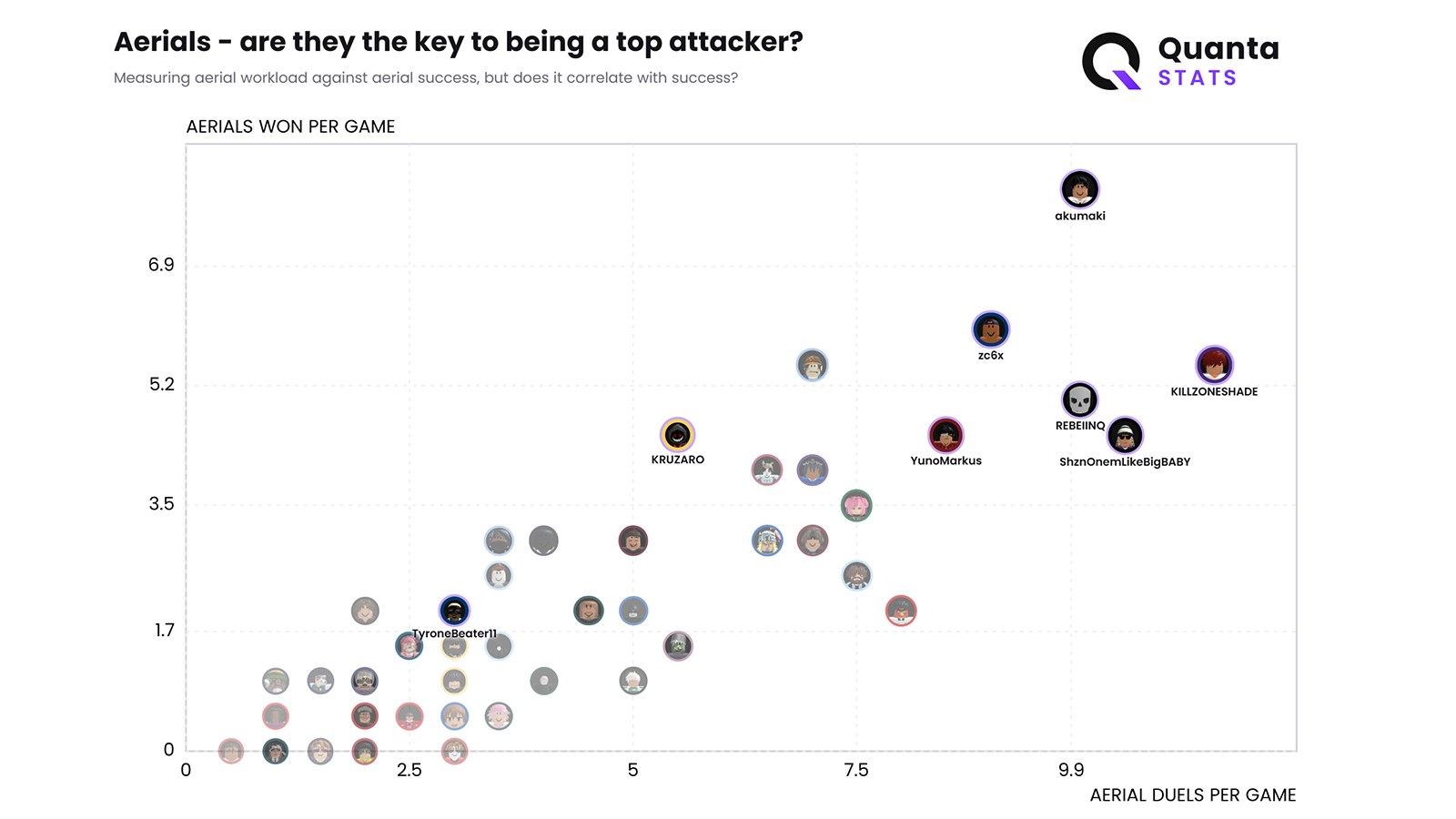
Some of Season 5's most productive attackers are also among its strongest aerial performers. But after two gameweeks, the data suggests aerial dominance is more likely to be an advantage than a requirement for attacking success.
The graph also highlights an important distinction between workload and ability. Some players are involved in a large number of contests without winning them at the same rate as the very strongest aerial performers. Others are involved less frequently but appear more efficient when those situations arise.
That matters because aerial volume is not simply a reflection of individual quality. It is also influenced heavily by tactical role. A striker used as a direct outlet will naturally contest more aerial balls than one operating in a side built around shorter passing combinations. Cross frequency, build up style and opposition approach can all shape how often a forward is asked to compete in the air.
This graph therefore tells us who is most prominent aerially. The more important question is whether that prominence actually translates into attacking production.
Aerial dominance meets attacking output
If aerial strength is an important ingredient in becoming a top attacker, the league's strongest performers in the air should begin to appear among its most productive players.
That is where comparing aerial wins with goals and assists per game becomes more revealing.
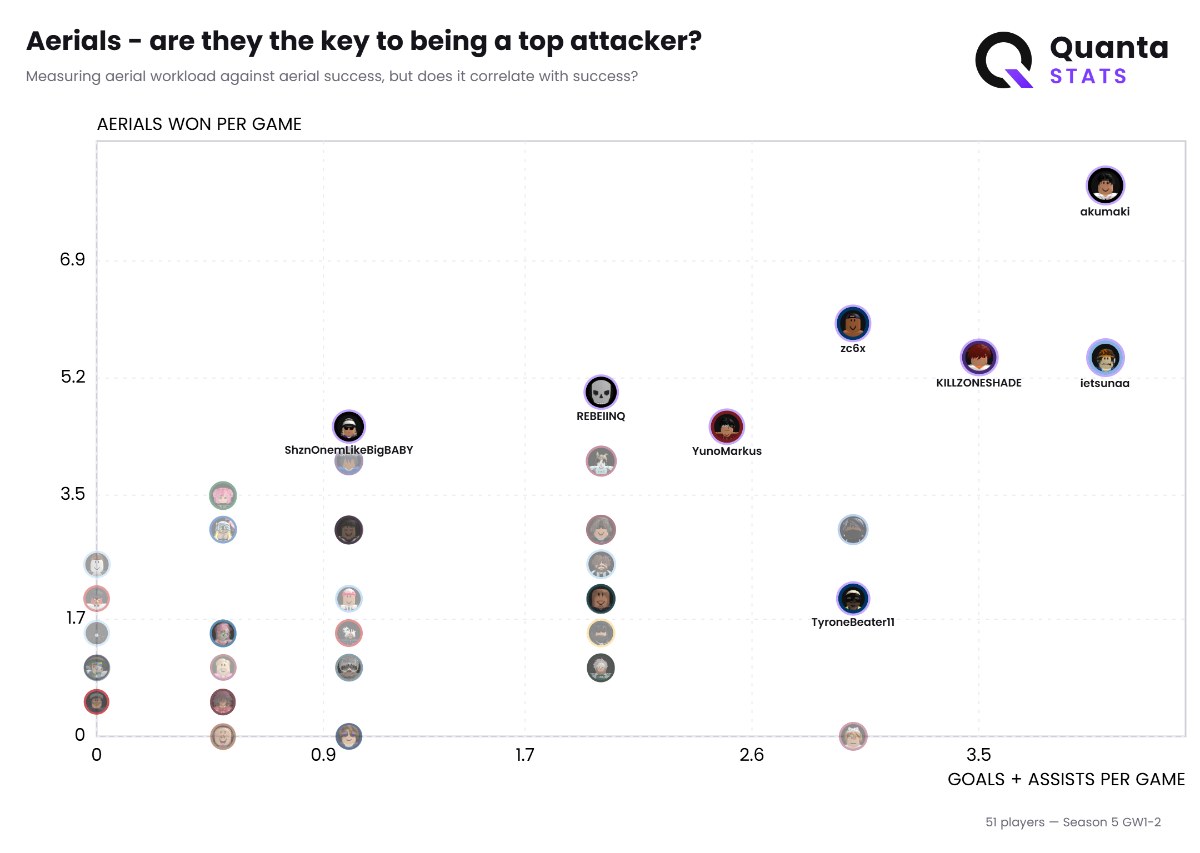
There is an early indication of a relationship.
Akumaki again occupies the extreme end of the graph, combining comfortably the highest aerial output in the sample with close to four goals or assists per game. Zc6x follows a similar pattern, pairing more than five aerial wins per match with strong attacking production.
Killzoneshade and ietsunaa also sit towards the upper right of the distribution, meaning several of the players producing the most goals and assists are simultaneously among the league's strongest aerial performers.
That provides some early evidence that aerial dominance can complement attacking output. It does not prove that one causes the other.
TyroneBeater11 offers one of the clearest counterexamples. His attacking output sits among the strongest in the sample despite winning fewer than two aerial duels per game.
Players can therefore reach similar levels of production through very different styles. That distinction becomes even clearer when aerial workload is removed from the equation.
Efficiency tells a different story
Total aerial wins tell us how much a player contributes in the air, but they remain heavily influenced by opportunity.
A forward who contests 12 aerial balls every game has far more chances to accumulate wins than somebody who contests three.
Aerial win percentage provides a different perspective by asking how often players actually succeed when they are involved.
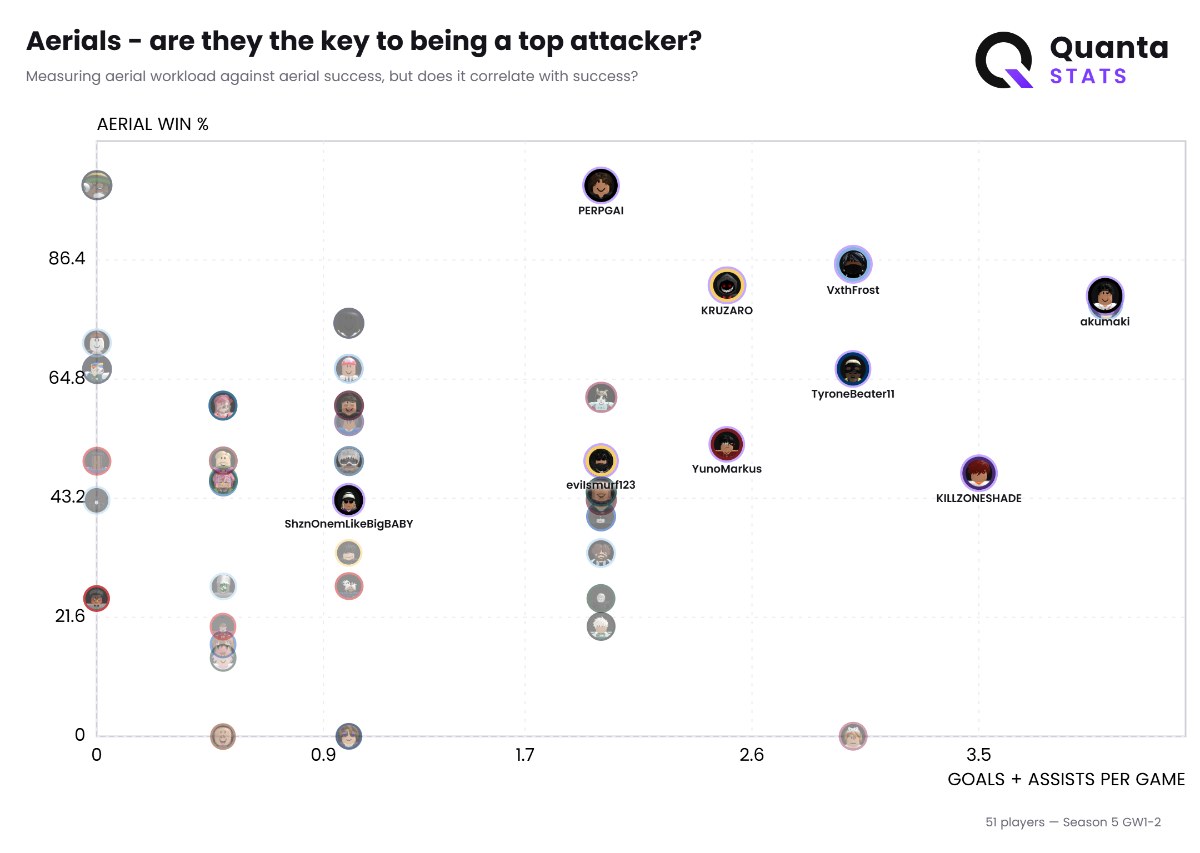
Here, the relationship becomes noticeably less clear.
Akumaki still stands out, combining exceptional attacking production with an aerial success rate well above 70 percent.
VxthFrost and KRUZARO also combine strong attacking returns with very high aerial efficiency, while PERPGAI sits towards the top of the percentage scale despite producing closer to two goals or assists per game.
That is important.
If aerial efficiency alone were closely linked to attacking quality, the strongest performers should be clustered towards the upper right of the graph. Instead, they are spread across a much wider range.
Killzoneshade has produced around three and a half goals or assists per match despite winning fewer than half of his aerial contests. YunoMarkus also combines strong output with a more moderate success rate, while TyroneBeater11 remains productive without reaching the very highest aerial percentages.
That suggests the original relationship is weaker once pure workload is stripped away.
Aerial ability still has value
None of this means aerial play is unimportant. Winning first contact can provide an outlet against pressure, create second ball situations, bring midfielders into attacks and allow teams to progress without having to play through every line.
For attackers such as Akumaki, aerial ability appears to sit alongside their existing attacking threat rather than replace it.
That can make a forward more difficult to defend. A player who can threaten in behind, combine with teammates and still consistently win direct balls forces defenders to deal with several different problems.
But the early data also demonstrates that aerial ability is only one route towards attacking effectiveness.
Some players are producing heavily without dominating in the air, while others are extremely efficient aerially without reaching the same level of goals and assists.
Context still matters
There are limitations to drawing firm conclusions after only two gameweeks.
Aerial win percentages in particular can be distorted by small samples. A player winning four of five aerial contests will appear considerably more dominant than somebody winning 15 of 25, despite the second player contributing far more overall. Those numbers should stabilise as the season progresses.
There is also no measure here of the quality or location of an aerial duel.
Winning a header inside the penalty area carries very different attacking value to winning a long clearance near the halfway line, even though both count equally within the raw statistic.
That makes tactical context essential when assessing what the numbers actually mean.
So, are aerials the key?
The opening evidence suggests not. What aerial ability does however appear to provide is another way for an attacker to influence matches.
Several of Season 5's most productive forwards are also strong in the air, and players such as Akumaki show what can happen when both traits exist together.
But the spread within the efficiency graph is equally important. High attacking output exists across a wide range of aerial profiles. For some players, dominating first contact may be central to their game. For others, movement, finishing, creativity or combination play provide an equally effective route to production.
After two gameweeks, the clearest conclusion is therefore not that aerial dominance creates elite attackers. It is that aerial strength can add another dimension to one.